The Arabian Sea is experiencing its coldest temperatures in 27 years... How will this affect autumn rainfall in the Arabian Peninsula?
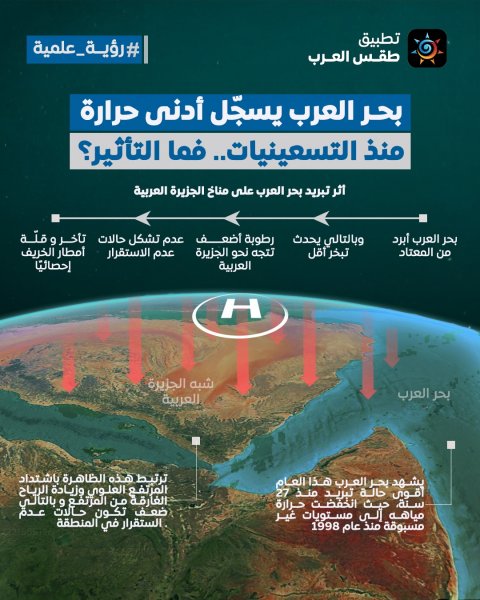
Arab Weather app - The Arabian Sea is experiencing its most significant cooling in 27 years this year, with surface temperatures dropping to levels not seen since 1998, due to changes in wind patterns and regional weather systems. This remarkable cooling is not only a phenomenon but also has a direct impact on the climate of the Arabian Peninsula, particularly on the performance of the autumn season, which relies heavily on the temperature of the Arabian Sea waters as a primary source of humidity.
The relationship between sea temperature and the rainfall cycle
The Arabian Sea is the primary reservoir of moisture that feeds the atmosphere with rising humidity, creating atmospheric instability that produces autumn rains across large parts of the Arabian Peninsula, including Saudi Arabia. As its surface temperature rises, evaporation increases and humidity levels rise, creating an ideal environment for the formation of cumulonimbus clouds.
However, in the case of cooling the sea surface as has been the case since the beginning of autumn, the evaporation process decreases, and the transfer of moisture towards the Arabian Peninsula weakens, which leads to a decrease in clouds and weak autumn rains.
Intensification of the upper-level high and sinking winds
Periods of cooling in the Arabian Sea typically see stronger activity of the upper-level subtropical high over the Arabian Peninsula. This high is accompanied by descending, dry air in the upper atmosphere, increasing atmospheric stability and weakening cloud formation. This, in turn, reduces the likelihood of regional atmospheric instability.
The cooling of the Arabian Sea to its lowest level in 27 years is not without consequences. It contributes to a strengthening of the upper-level high and a weakening of tropical moisture, resulting in delayed and relatively weak autumn rains across the Arabian Peninsula. However, weather patterns remain fluid, and the coming weeks may bring a gradual improvement as tropical systems move in or the upper-level high weakens, God willing.
O God, send down rain upon us and do not make us among those who despair.
Browse on the official website