Areas of several Arab countries witness the phenomenon of lack of shadow at noon Monday, June 21
Weather of Arabia - Every year, a part of the world witnesses an unusual natural phenomenon that can make the scenery of things in the real world appear to have been modified using Photoshop, which is the phenomenon of the absence of shadows of things at noon.

(A picture of a tree at the time of the phenomenon of lack of shade, we note how the leaves and branches block the sun’s rays without any shade, so the image of the leaves and branches appears completely opposite of the true shape and size)
Tropic of Cancer and the summer solstice
The phenomenon of noon shadow occurs in parts of several Arab countries on the summer solstice on June 21 every year, due to the occurrence of these areas on the Tropic of Cancer at latitude 23.5 north, which the sun perpendicular to on the summer solstice.
The Tropic of Cancer passes over the lands of 17 countries in the world, all of which witness the phenomenon of the absence of noon shadow on the day of the summer solstice, and among the Arab countries in which the Tropic of Cancer passes over their territories are: Algeria and Western Sahara - Libya - Mauritania - Egypt - Saudi Arabia - UAE - Oman
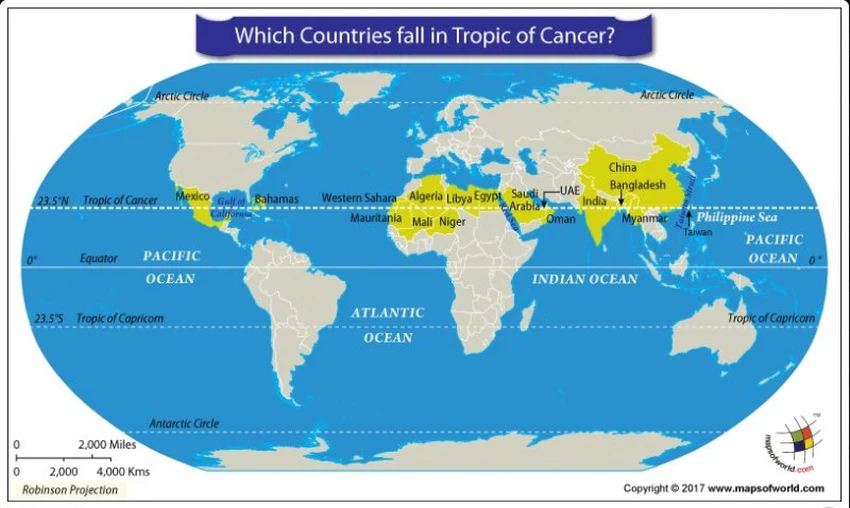
The 17 countries in the world - in yellow - through which the Tropic of Cancer passes)
The regions of the Arab countries that will witness the absence of the shadow of noon on (21 June)
- Saudi Arabia:
The Tropic of Cancer passes over the territory of Saudi Arabia with a length of 1380 km, and Saudi Arabia is the fourth country in the world to have this length of the Tropic of Cancer after India, China, and Algeria. The Tropic of Cancer cuts across almost the central parts of Saudi Arabia. The most prominent governorates and centers it passes through are:
About 15 km north of Yabreen - Hotat Bani Tamim - Al Hilweh - south of Naam - Al Hariq about 16 km - south of Al Rayn about 9 km - south of Halban about 1.5 km - south of Al Khaira about 4 km - south of Mahd Al Dhahab by about 3 km - north of Al Suwayriya about 10 km - south of Al Yatmah by about 2 km - South of Badr, about 32 km, south of Al-Rais, about 10 km.

(The map shows the areas through which the Tropic of Cancer passes - the yellow line - in Oman, UAE and Saudi Arabia)
- UAE:
The Tropic of Cancer cuts across the southern parts of the Emirates, and passes through the areas that will witness the absence of noon shade in the country: north of Umm al-Zamoul - Liwa - south of Madinat Zayed - al-Quaa. And the absence of the shadow of the meridian occurs with the time of noon on (June 21), which leads to not seeing the shadow of people and buildings during the time of noon.
- Oman :
The Tropic of Cancer cuts across the northern parts of the Sultanate of Oman, and passes through the following areas: As Sifah (Muscat Governorate) - Al Amerat (Muscat Governorate) - Fanja (Al Dakhiliyah Governorate) - Wadi Al Ma’awil (Al Batinah Province) - Al Rustaq (Al Batinah Province) - Ibri (Al Dhahirah Governorate) .
- Egypt, Libya, Algeria and Mauritania:
The Tropic of Cancer cuts across the southern parts of Egypt, Libya and Algeria, passes south of Aswan in Egypt, south of Al-Jawf in Libya, and passes through the arid Tanzeroft Desert and Mount Tahat in Algeria. As for Mauritania, the Tropic of Cancer crosses the northern parts of it, in the desert region.
Other regions experience a lack of noon shadows at different times of the year
On the two equinoxes, which occur around March 20 (vernal equinox) and September 20 (autumn equinox), the sun's rays are directly above the equator so that it hits the Earth at a 90-degree angle. This causes towns along the equator to see no shadows at noon on the equinoxes.
Direct rays from the sun gradually shift north in the months leading up to the northern hemisphere summer solstice in June, when the sun is perpendicular to the Tropic of Cancer in the northern hemisphere.
Then, direct rays from the sun turn south each day until the December winter solstice, when the sun's rays perpendicular to the Tropic of Capricorn south of the equator.
Because of this back-and-forth motion, all regions between the Tropic of Capricorn and the Tropic of Cancer experience perpendicular sunlight twice a year.

Browse on the official website